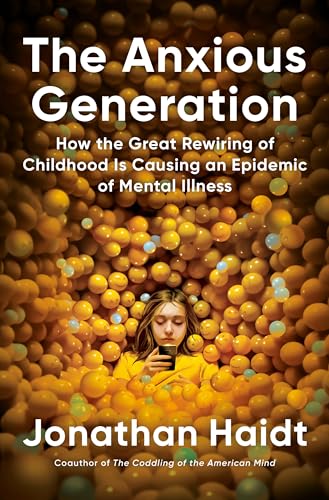
by Jonathan Haidt
Screens glow through the night,
Childhood lost in scrolling feeds—
Let them climb again.
Jonathan Haidt’s The Anxious Generation wastes no time in sounding the alarm: we are raising children in a radically altered environment, and the consequences are showing up in their mental health. With clarity and urgency, Haidt makes a compelling case that the rise of anxiety and depression among young people is no accident. It’s the result of a generational experiment in which childhood has become more virtual, less physical, and—most critically—less free. This book is both a diagnosis and a call to action, urging parents, educators, and policymakers to reverse course before the damage becomes irreversible.
The main theme of the book centers on how childhood has shifted from being play-based and community-driven to screen-based and isolated. Haidt argues that this transformation began around the early 2010s, when the smartphone, social media, and hyper-connected digital platforms became the dominant environments for adolescents. These tools, designed to captivate, have quietly reshaped social norms and undermined the developmental needs of kids and teens. Drawing on a wide range of research, Haidt outlines how the “phone-based childhood” has led to a rise in loneliness, diminished attention spans, and alarming increases in anxiety, especially among girls. He doesn’t point fingers at any one company or technology, but instead explores the cultural shift that has allowed devices to become central to kids’ lives while freedom, risk-taking, and outdoor play have faded away. His message is clear: kids need less screen time and more real time—in nature, in play, and in unstructured spaces.
Haidt’s vision is both philosophical and practical. He believes that society has lost sight of what childhood is for—that it’s a time for experimentation, resilience-building, and social development in the real world. His execution is thoughtful and thorough. He doesn’t simply lament what’s gone wrong; he offers a road map to reclaim childhood. From setting device boundaries to rethinking school policies and encouraging community-building, Haidt presents a multi-layered plan for restoring balance. He acknowledges the complexity of modern parenting and doesn’t condescend to families caught in the digital current. Instead, he writes with a sense of solidarity and shared responsibility, making this book feel like a conversation rather than a lecture. While some of his recommendations may feel difficult in today’s hyper-connected world, they are grounded in common sense and backed by strong evidence.
The Anxious Generation is a must-read for parents, teachers, school administrators, and anyone concerned with the wellbeing of kids and teens. It’s especially useful for readers who sense something has shifted in childhood, even if they can’t quite name it. This book is best read on a quiet weekend, ideally somewhere away from screens—a cabin, a sunny porch, or even during a device-free retreat. It’s the kind of book that makes you pause, reflect, and—if you’re a parent—maybe even hand your kid a stick and tell them to go outside and build something. Haidt offers not just critique, but hope. And in an anxious age, hope may be the most powerful message of all.


 The Haiku Review
Leave a comment